Saturday, July 30, 2022

Retrospective on the Monstrous Manual

Tarrasque as featured in
The Monstrous Manual
©️ 1993 TSR, Inc.
 
 I will start by saying that I am an inveterate teratophile; I cannot get enough of monsters. I love having huge stacks of them to read, daydreaming up adventures in which they might appear, and running test battles against them.

I realize that it isn't actually very useful to have too many monsters. You don't need more than a handful to make for a good game of D&D. Not to mention that building a new monster for a TSR-era edition of Dungeons & Dragons doesn't actually require very much work, You can put one together in about three minutes if you know what pages to look at.

A good book of monsters is more of a convenience, or a piece of art on the wall of your campaign.

Friday, July 29, 2022

How I Use Rumor Tables to Create a Living Campaign

I wanted to share a tool I used to keep 1:1 (ish) time running and my Silver Gull Swords & Wizardry campaign a living thing: My rumor charts. these were posted every game day that the players were not starting in a dungeon, to give them something to do. (Finch's player has established that he would carouse once a week at least to keep the table fresh.)

Tuesday, July 26, 2022

My Alternative XP system

 I was talking with Russ over at Yum/DM about using the traditional OD&D / AD&D treasure for XP system, and how it tends to strongly constrain play to one style.

This is fair. I have been playing in the Weirth campaign for two years with the treasure for XP rules, training, and expensive hirelings... Not to mention very profitable carousing. I enjoy this style of game. But it has had it's downside. Some players feel a pressing desire to follow certain emergent plots... Like a prophecy we believe we can follow to put a stop the walking dead from rising... While others just want to level up, even if it means putting big heroic deeds off to tomorrow.

My System 

I personally prefer a slightly looser system of rewards  that keep the players seeking adventure, but don't require them to chase the almighty gold piece if they don't feel like it.

I have used a hybrid system based on a mix of Dungeon Crawl Classics RPG from Goodman Games and the system presented in The Dozen Dooms by Baldrage. Here is my basics:

PCs are rewarded XP for overcoming challenges.

"Overcoming Challenges"

What counts of overcoming is contextual. The encounter must carry risk of mission failure, injury loss of resources, or humiliation to count as a challenge. And players must require more than a single roll to solve the problem: it must be role-played in some way other than "making a check."

The challenge is overcome when the PCs neutralize the problem in a way that lets them move towards their current goals. But the how is not important. In fact, creativity is encouraged.

Sunday, July 24, 2022

AD&D Treasure Types from 1e to 2e

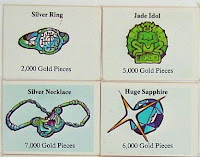
Treasure cards from Dungeon!
©️1980, TSR, Inc.
UPDATE: I found that there was some confusion with my original sources about which edition was which in terms of when thematic treasure types were used. AD&D was conflated with OD&D in a few places. I have reworked the article to reflect the editions more accurately.

 I recently treated myself to the Advanced Dungeons & Dragons Player's Handbook and Dungeon Master's Guide.and the AD&D 2nd Edition Monstrous Manual in an attempt to create an optimal Dungeons & Dragons experience for my play style and module writing. Assassins and Monks, weird Gygaxian prose, xp for gp, and more monsters than you can ever possibly use. This was an excellent plan with one major flaw:

Treasure Tables.

In AD&D the Random Generation by Treasure Type tables were in the Monster Manual. In AD&D2e, the table was in the Dungeon Master's Guide. Ergo, I have no table except the one in my Rules Cyclopedia, which I know is mathematically not really lined up with AD&D.

So, I decided that I needed to take a deep dive into the first and second edition treasure types to understand how they worked and which I should be using for my game. I also immediately got an idea for a cool project.

The AD&D Treasure Types

I am going to preface this by saying that I did a lot of reading from some awesome people, such as a number of posters on Dragonsfoot.org. I have a bibliography at the end of this article. I also was fortunate enough to find the original AD&D tables on GM's Binder. 

Low Reproduction of Tables

And this was fortuitous, as most retroclones do not reproduce the treasure type system. The first retroclones tried very hard not to exactly reproduce any tables, as they were worried that this would be a legitimate grounds for complaint and compromise the legal harbor they were attempting to establish. When it came to the random treasure table, this became a problem. OSRIC simply tossed the whole system. So did Swords & Wizardry, which offers an alternative system that gives approximately the right gold for Dungeon encounters. 

This has become a sort of tradition: like descending AC, treasure types are one of the first things to be pitched or simplified.

Fungibility of the System
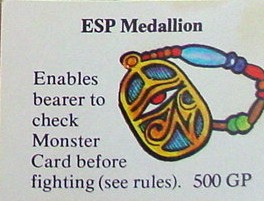
ESP Medallion Card from Dungeon!
©️1980, TSR, Inc.

Treasure Types as a system actually pretty easy to toss. Types A-I are the Treasure found in wilderness encounters only if a large number of the creatures are found (close to the maximum number), and then backtracked to their lair. 

For some monsters, like orcs, you are going to find way smaller numbers of them in dungeons than the 3-300 you might find outdoors. If you find an in-dungeon lair with a dozen or so orcs, such as in Keep on the Borderland's Caves of Chaos, You don't use Treasure Types at in that case instead, you would roll for a treasure appropriate to the dungeon level.

It's only when you run into a monster lair for a monster primarily found in dungeons,  like a mind flyer, that treasure type comes into play in AD&D, although a level-appropriate treasure can be substituted at the DM's option. It's no wonder OSRIC omits it.

Friday, July 22, 2022

The Reproductive Cycle of Dungeons


Unkeyed map of the Imrani Waste
as explored by my players so far
Created with Hextml
A few days ago, I posted a summary of my "Silver Gulls" campaign to date. (Although I forgot a Ffve-room dungeon.) And I wanted to share something I discovered.

When the PCs stepped into the Teleportation Booth all together and started mashing buttons, I knew that they would wind up in the middle of the desert 20-ish miles from a town and 500 miles away. I drew a hex-bloom of desert landscape around them and roughed-in several locations.

The Facts About Xen

I didn't know much about the region but I had some truisms about the campaign:

  • The Empire of Xen has collapsed four times over 4,200 years, but claims to be the same nation (a dubious claim)
  • Each Collapse has left ruins, often buried and forgotten.
  • The Empire doesn't know its own history very well. 80% of it's cultural past is forgotten.
  • Many of my past campaigns are ancient pre-Imperial history.

With that in mind, I put an oracle tended by cactus-men, a temple surrounded by a perilous cactus forest, a prison colony that is haunted by its inmates and built over a cavern that leads to an underground river and sunken ruins. And an old smuggler camp that once supplied the convicts with contraband. I also knew that there was an oasis to the north of the town.

I also decided that the town would be on a petrified forest and have human petrification problems related to evil in a nearby dungeon.

That was actually a lot for an area they might choose to leave right away. I left details scant.

Tuesday, July 19, 2022

The Silver Gull Campaign (a Summary after 22 sessions)

This is one of those stories I tell you so I can tell you another one. I wanted to describe my most involved Xen campaign (which I call The Silver Gull campaign) in broad strokes, becaue I wanted to talk about how my setting has evolved, and tools I have discovered in a follow-up article.

You can read my Xen campaign resource here.

The Campaign started when Zeelagur, a human monk who is an escaped gladiator, Finch a human monk and retired pirate, and Reine, a kooet thief and underworld alchemist were hired by a shady wizard to retrieve a lost spellbook from a ruin in Southern Cathbad.

Dungeon 1: The Astrologer's Tower (11 Rooms)

The ruin was a tower that had been buried in sedimentary stone due to glacial movement 2,200 years earlier, and it's location lost for centuries. Inside was the great orrery and library of an order of astrologers that once served the imperial court of Xen before the last ice age... Only it turned out that he was secretly sending them in as a hostage exchange to free his apprentice, who was being held by kobolds within.

Dungeon 2: The Leaning Tower (5 Rooms)

While exploring the ruin the PCs accidentally activated a teleportation booth and ended up in a ruined tower 500 miles away in a hot, arid part of the Cathmari desert. The tilted, sand-filled tower they arrived in was a remote wizard's tower from the same era that was built to absorb ley line energy for the charging of magitechnical devices... and as an observatory.

Dungeon 3: The Prison Colony (12 Rooms)

Stealing an ornithopter from the tower, the PCs arrived at a ruined prison colony and were nearly overrun by the shades of the dead prisoners. Taking shelter in a ruined church, they discovered the mad spectre of the religious zealot prison warden. In a show of some of the best fast-talk I had ever seen, they convinced the Warden to move on to the Cold Hells where he could carry out his work.

Hell was so impressed they sent an emissary to offer them a deal, the Cold Hells would save them from the shades if they went on a quest for Hell itself to disrupt the politics in the city of Pamuk.

They opted to leave rather than explore the caverns they discovered down the well beneath the prison.

Friday, July 15, 2022

Reviewing the POD Quality of AD&D Manuals

 Last month I had a banner month of sales, especially once I finally got Strange Ways up on DriveThru RPG. Enough for me to buy myself a rare treat: The hardcover rerints of the AD&D1e Player's Handbook and Dungeon Master's Guide, as well as the AD&D2e Monstrous Manual. I feel that this combination of manuals will give me the best AD&D experience, and the best concentration of OSR monsters in one place (so long as I print out the BECMI / AD&D2e treasure tables.)

When I first saw that these were available, I had a lot of questions about quality that I wished someone would answer, and each time I see someone share that they have bout these on Twitter, I see those same questions. Namely, how is the reproduction quality? Are they accurate reproductions?

So I thought I would put in my two cents on the books I have as physical objects. Then I might discuss the content separately.

Warnings

I know some people were wondering if the obnoxious cover warnings that appear on the PDFs are there in the print versions. They are not.

Covers

The hard covers are solid. at least for the printer (in Etobicoke, ON) that my POD copies were made gave me a thick, durable cover. My son dropped my PHB on its corners and they did not blunt or crinkle. I dropped the DMG on my foot and the corners punctured my skin. They have not managed to accrue any nicks or scratches of not in a week of heavy reading and riding around in a backpack.