Showing posts with label Classic Adventures. Show all posts

Saturday, May 30, 2026

What I'm Up To

 I'm sure it has been missed by no one that I have been having trouble finding time for this blog. And it's anniversary has just rolled past. So I wanted to take some time to let you know what has been keeping me busy, as it is mostly RPG-adjacent.

Gaming!

Death in Space

I'm coming up on one year of an intense campaign in Death in Space. My players have managed to survive long enough to salvage a handful of functional ships, hired a crew of salvage and mining experts and built a network of laser communication satellites; they are trying to become a force for hope in the Tenebris system.

The game started as a one-shot pallette cleanser, and just kept going. So I didn't start posting play reports until it is too late.

The Weirth Campaign 

I've also been participating in a long-running campaign run by Stephen Smith that attempts to reconstruct the early 1970s Wargaming D&D experience. We've shifted systems a couple of times, including playing awhile using the 1973 D&D play test rules that were recreated in The Lost Dungeons of Tonisborg, fueled with and eventually replaced by Blueholme, and after a few years shifting to a highly home-brewed iteration of Tales of Argosa.

This game uses domain rules that start for fighters at level 2, one-to-one time, patron players, mass combat played in Chainmail and other retro wargames, and a ton of classic modules including the aforementioned Tonisborg, The Tower of Xenopus, Keep on the Borderlands, The Isle of Dread, Temple of Elemental Evil, Empire of the East, Mask of Nyarlathotep, Into the Depths of the Earth, Veins of the Earth, Please Go to Sleep Arthur Cobblesworth, Sounds of the Mushroom Kingdom, and Against the Cult of the Reptile God among others.

Home Game

My home game with family has had a couple of false starts, but I just brought a satisfying end to a DCC RPG campaign and am setting up a game in AD&D.

I've also been playing a solo game in Grok?! 2e, amplified by Mythic Game Master Emulator.

Summer Game

Every year in the Summer I try to run six sessions of a classic OSR game with family, friends, and my favorite D&D people. This year I am vacillating between PARANOIA SP1 or running Operation Unfathomable and Odious Uplands in Swords & Wizardry.

Podcasting 

Two years ago, I founded an audio production company, Stormhead Productions, with terrible timing. The Descript AI changed audio production overnight about the same time I started my business. I was putting up a freelance profile on Upwork the exact same time that the going rate for that work were cut in half and the available jobs shrank by two thirds.

Sunday, July 21, 2024

The Adventure Game Part of D&D Directs the Faction-Driven Wargame Part

I want to amplify a topic recently posted in Bradford C. Walker's substack  entitled Clubhouse Row (Part One: A Proper D&D Club):

The dungeon delving is the side show to the real game, which is the contention between factions vying for dominance over the land. It is a wargame first and an adventure game second.

Specifically, it is a faction-based wargame where Player-vs-Player conflict is core to the game. AD&D1e handles this without needing supplements. The actions of the factions shape the setting, and smaller adventuring bands can take advantage of the liminal spaces between them (literal and metaphorical alike) to seek out their own objectives (often as not found in a dungeon somewhere). [ibid.]

I'm not sure I see D&D as a wargame first, but I definitely see that the adventure game is informing a very different wargame going on behind the DM's screen: One of the most interesting ways in which Dungeons & Dragons retains its war game structure is in the way factions are played especially in old school games. 

A well set-up community has several different factions vying for control and influence over the community. This can be the villains, but it can also be various peaceful groups within the town. 

Tuesday, July 2, 2024

Tailoring a Campaign: My Player Resource for Running Hot Springs Island

I am in the process of setting up for my Summer game of Hot Springs Island. One of the first things I wanted to do aside from sending out the pitch document that I shared with you last week, was to write a guide for the players. This guide had to tackle some basic tasks:

  1. Cover how to make a character
  2. Reiterate at least some of the house rules in the pitch document.
  3. Expand on the information in the pitch for players who have bought in.
  4. Add in any new content relevant to the players.

So I started by reiterating my character generation process. I added in firearm rules cribbed from Lamentations of the Flame Princess, and a gear list that brings the characters into the 17th century, including some era-appropriate armour and equipment.

Tuesday, June 25, 2024

Example of Tailoring A Campaign: My Summer Vacation Game


I've recently experienced a severe stall in my Silver Gull campaign.. a couple of my players suffer from chronic illnesses that have been bad lately, and they haven't been able to make it. While my campaign is normally run in one to one time, my players aren't really interested in playing unless they have the full group available. Another of my players has a psychological block when it comes to trying to run multiple characters at once. He simply isn't able to do it, and so it doesn't want to start anything on the side. 

The end result is that my players have needed to move to a pause time model of play, and then we have been unable to play simply because some of my players are being too sick.

I'm not willing to give up on the Silver Gull. This campaign has been one of the most enjoyable I've ever run. And, in spite of stalls and brakes, the player characters are now sitting between 7th and 10th level depending on class. They have intrigues, long term goals, romances, sworn enemies, holy missions, and are building towards a dominion now. 

But I get the feeling that things are not going to work themselves out for another few months.

And so, I've decided that for the Summer I'm going to be running something a little different. And this is where tailoring your game to the campaign is absolutely vital.

Friday, June 7, 2024

Making Best Use of Downtime

Many of my players don't like downtime. They want a fast-paced adventure where they know danger is around every corner. They prefer the kind of pacing that you see in modern Dungeons & Dragons play. Downtime for them is like a montage. And for many years, because I know my audience, that was how I played. Downtime only existed between acts or when the PCs decided to- and the unfolding events allowed them to- take a break.

The Evolution of Timekeeping Advice in D&D

As a kid, I missed reading the 1st edition Advanced Dungeons & Dragons Dungeon Master's Guide, I missed out on its advice for keeping time and running the game (I went from playing with the Mentzer "red box" Basic Dungeons & Dragons to using Mentzer Dungeon Master's Rulebook and the AD&D Player's Handbook, to using AD&D2nd edition. Thus, I missed the best resource ever written on running a D&D campaign. The AD&D2e Dungeon Master's Guide buried its advice a somewhat in favour of optional rules and setting design, and skipped some of the best options. Bu the time they decided to expand it in DMGR1: The Campaign Sourcebook and Catacombs Guide, the developers at TSR had very much moved away from Gygax. Here is the meat of their description of how to manage pacing of a campaign in DMGR1:

Thursday, February 1, 2024

Let's Talk Adventures: DCC #68: The People of the Pit

Author
: Joseph Goodman
Publisher: Goodman Games
Marketplace: Goodman Games, DrivethruRPG 
System: Dungeon Crawl Classics RPG 

I first played The People of the Pit in March of 2019 and I have very fond memories from this module.

At that time, I had joined the Dungeon Crawlers Discord, a DCC fan board that I was assured had a great LFG section, and was not disappointed.  I joined a group that was going to meet every Thursday. We would play either a published Goodman Games module, playtest our own module, or bring an adventure of the right approximate length, and run it. As soon as we were done, the GM would rotate. We all had our own PCs, but they,would not be allowed a vote in party decisions while we played.

We started with Sailors on a Starless Sea, which only two of my six characters survived. One of them, Podrux, immediately became a group favourite.  A tailor, but a wealthy one with gems in his pocket, Podrux wasn't raiding the citadel of Chaos because he was trying to save his kin... No, he was on this adventure because these bastards owed him money, and they can't pay up if they're dead. My fellow players loved the cowardly,  greedy, sarcastic bastard who was really the village usurer. Especially as he got his hands on magic power and immediately started trying to figure out how to get more.

Our second game was a playtest of my module Vikings on a Starry Sea, which I will publish one day. Followed by a GM who had a plot in mind, and started setting up what would be his own episodic plot. In which Podrux defrauded a town of incredible wealth, sacrificed some pets, and started courting power from a few patrons.

And then came The People of the Pit. This Sprawling Dungeon was one of the weirdest I'd ever encountered in a way I'd really liked. It is, to me, one of the defining modules of the Dungeon Crawl Classics catalogue. Given that it was the second DCC module released for Goodman Games' own new TTRPG, it had to be. I would not be surprised if it was a big portion of the reason Goodman Games was such a hit.

Thursday, January 25, 2024

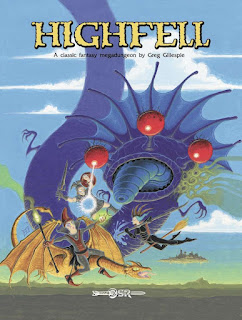
Let's Talk Adventures: Highfell

 I am going to experiment with a slightly more conversational tone to discuss some of the big modules out there in the OSR and beyond, rather than giving them the lengthy, structured approach I give to TTRPGs here. Partially in the name of doing more with this blog, and partially because I feel the value you get from a module depends very much on what you intend to do with it, and partially because I am, as always, here to share the things I find awesome. And you all don't always want to read 20 paragraphs.

So I am going to start this experiment with Highfell: The Drifting Dungeon.

Highfell: The Drifting Dungeon

Author: Greg Gillespie
Publisher: OSR Publishing
Marketplace: DrivethruRPG,
System: OSR Compatible

Greg Gillespie is probab;ly one of those designers who doesn't need much by way of introduction. He has a pretty good reputation in the OSR community for his massive and complex modules.

Every couple of years Greg Gillespie releases aa new module that he has been hammering away at, often daily for years. His first one, Barrowmaze, is legendary: a sprawling labyrinth of barrows in a haunted valley that is peopled by undead, strange magical monstrosities, and terrible curses. As the PCs explore this on-floor labyrinth they will find that trditional "levels" are replaced by zones that are inreasingly deadly as you push further away from the nearby town. Sattered runestones introduce a new kind of magic, and there is a history of the place that can be learned by clues.

Highfell: the Drifting Dungeon, along with Dwarrowdeep are two follow-up megadungeons. They are offered in both OSR and D&D5e versions. with the OSR versions being mostly structured along the conventions of AD&D / OSRIC, meaning you will see relatively middling stats for NPCs, high stats for the pre-gen PCs, and two-part alignments, but as always, OSR is OSR, you can convert anything for a B/X system like Old-School Essentials in a few seconds in your head as a veteran GM.

All three modules are set in a consistent world, and Dwarrowdeep and Highfell cross over with one another and have cross-over material from Barrowmaze seeded into them. As a clever manoevre, most of the towns and villages of the settin make menton of cities with familiar names like "Threshold" allowing a comfortable drop into existing D&D worlds like Mystara.

This module is pretty much a full canned campaign: you have a hometown with enough factions and intrigue to make time in  "Town" compelling play, and a pretty big cast of NPCs. A couple of smaller villages that have enough details to make them interesting, A few adventure sites, and then one immense megadungeon. Like Keep on the Borderlands or Temple of Elemental Evil there is enough material beyond the dungeon to run a whole campaign, probably for years if you want to.

Wednesday, January 10, 2024

Why I Don't Often Review Modules (Trying Something New)

 You know, I've built up a pretty big stock of adventure modules over the last few years. Thanks to Humble Bundle, Bundle of Holding, Itch.io jams, and that absolutely bodacious sale Jim Raggi put on last year, I probably have enough to keep me in review content for years without breaking a sweat or spending another dime.

The fact is though, I only discuss modules for the most part when they also do something interesting mechanically or culturally:

The Hill Cantons Quartet had the incredible Chaos Index tool, weird monsters and a sense of humor that made it a joy to play. It was the quartet of creations that put The Hydra Cooperative on everyone's map.

Sailors on the Starless Sea helped redefine a genre and set the unique tone of the most popular OSR game ever made.

Cha'alt and its companions have an innovative game woven into its pages, and tons of mechanics for things like mutations, capricious gods, and a totally different way of approaching magic. Not to mention being a prime example of gonzo style play.

Islands of the Purple Haunted Putrescence for its sheer scope as a hexcrawl, and willingness to toss genre an pop culture into a  lender and set it to frappé. 

Into the Demon Idol is a favorite example of a one-page dungeon.

Frostbitten & Mutilated with its dice scatter tables, clever handling of time travel, dark and twisted character classes, and serving as a prime example of the unique design principles of Lamentations of the Flame Princess. 

Hot Springs Island a massive, stylish  system-neutral hexcrawl that exemplifies setting design, and has a truly amazing way of presenting NPCs.

The Ultraviolet Grasslands and the Black City, is a book that is beautiful and supremely imaginitive. It takes the concept of the pilgrimage and makes it into a rich and surreal experience.

Arête is a great example of mythic D&D at its best. And I used it to experiment in solo play.

DNGN Issue #1 was an interesting experiment in presentation. 

The Winds of Madness was sent to me by a reader and was an absolutely stunning romp through the Far Plane with Githyanki and Spelljammer ships that did a better job of the Spelljammer setting than WotC did. It is also a great case study in the differences between the way adventures are designed in OSR and 5e cultures.

The Abandoned Estate of Moonweaver Hall I reviewed mostly because I wanted to encourage a first-time writer who was being dogpiked by asshokes on Twitter who didn't  care for his cover. I  thought a little honest feedback might help him out and keep him from being driven out by cancel-culture asses.

Each review was there because the module was an exemplar, a talking point, or a tool for developing my ideas, as much as it was a review of the product itself. I wanted to explore something that the specific setting had to offer.

I also have played most of them. Some of them twice.

My collection, which includes around forty DCC RPG adventures, a dozen Lamentations of the Flame Princess modules, a modest collection of classic D&D adventures, a shocking number of Blue Rose books, the Alpha Blue THOT trilogy, most of the early Necrotic Gnome OSE modules, Rappan Athuk, Highfell, The Lost Dungeons of Tonisborg, Nevin Pendlebrook's Perilous Pantry, Warhammer Fantasy RPG 1e's Enemy Within series pretty much the entire 1st and early 2nd edition PARANOIA libraries is brimming with adventures good, bad, and extremely weird. I have a lot of thoughts I could share on almost all of them.

But I really hesitate to do so. For a simple reason:

There's just too many ways to use them.

I have run quite a few modules over the years exactly as written. Others, I have stolen the map and a few treasure hoards, or maybe I grab some useful mechanical ideas, monsters, or traps. How you use your module will make some modules more valuable than others. If you are looking for a traditional campaign to run, Hot Springs Island, The Temple of Elemental Evil (especially combined with the Giants and Underdark series) are probably the best bets. If you want to run a long game that doesn't fit that traditional mold, you might be better off considering The Ultaviolet Grasslands and Black City or Cha'alt. If you are just looking for a few good ideas to pillage, the Hill Cantons quartet is a fertile ground for plunder. If you want a very finite game that will liast seven sessions or so, A Red and Pleasant Land or The Islands of Purple Haunted Putrescence are great. Need some ideas for your PCs after they took a sip from a hag's cauldron? Grab Narcosa or Sounds of the Mushroom Kingdom. Need something you can run right now? The One Page Dungeon Compendium or almost any level-appropriate DCC module will do the job. Looking for good fodder for a solo crawl? Rappan Athuk, all the way!

I can definitely give a good factual rundown of a module's properties and major strengths and weaknesses. But I am not sure it would make for interesting reading.

Honestly, the best way to review modules is probbaly something like the best way of reviewing movies: you need to cultivate a persona that grabs one audience, and then  recommend books to that audience. Bryce Lynch over at 10ft. Pole, for example has perfected the angry, disaffected GenX DM who just wants to run the game, not spend all day planning shit. His audience are GMs who want to run something without tweaks, as written, and not spend their time or energy on something unless it has a twist.

Which isn't me. I love prep. A module has to be really special for me to want to run it "as is" out of the box. I'd do it again for Hot Springs Island or Highfell, and one day I would love to run Ultraviolet Grasslands and the Black City. But, on a whole, I want to plunder a  module for good ideas. 

Often I want something I can put somewhere on my sandbox after modifying it to suit my needs, like I did for Into the Demon Idol in my article on how to use one-page dungeons. This may well be my favorite way to use modules. And because of it, I suspect that adventures that would be poorly reviewed on 10ft, Pole as humdrum or underdeveloped might receieve a kinder review here. And some of the modules he finds interesting hold little appeal to me, as they are not really compatible with my style of play.

There is another issue as well:

While Modules are fun to read, collect, and plunder, I prefer to home-brew.

Modules are a frippery. You don't need them. Most of the ones I have collected, I have done so purely because I am a fan of the module, or I am curious about the module after seeing it teased out on a YouTube channel like Questing Beast. Or it is in a bundle along with a game that I really want to review.

At the end of the day, if you want to be the best GM possible, learning to plan efficiently is one of the most important skills you can hone.

But...

As I have thought long and hard on this topic lately, I find myself wondering: would my sandbox-play and rules-hacking approach be valuable if I started adding more modules to my rotation?

Or could I develop a more casual structure to share my thoughts on some of the cool modules in my collection that doesn't take me ages to write as I do when reviewing a game? It bears some experiementation...

Over the month, I am going to compose a few different styles of short article to discuss some of my favourite modules. I hope one of them might land with my readers. Please let me know when one does.

Wednesday, September 20, 2023

Classic SciFi TTRPG Roundup

 Thanks to Thomas for the great prompt.

I haven't got on the Starfield bandwagon. Honestly, I'm not even sure I have the hardware to run it. But it certainly has revitalized an interest in space opera and classic scifi pulp in the gaming world.

Personally, I've caught the same bug from playing No Man's Sky lately. I got it for my birthday in June, played the hell out of it for a bit, then went traveling in the Summer. To keep scratching the itch for space exploration NMS gave me, I created the Starfarer setting, and ran a pretty lengthy solo game using a combination of Mythic GM Emulator and RPG Pundit Presents #100: Star Adventurer 

Being able to blast off into space and enjoy some campy Sci-Fi action is definitely on the minds of myself, my gaming group, and a lot of my friends.

That in mind I'm going to talk about some of the classic science fiction role playing games out there if you're looking to scratch that itch and you're not interested in something as new school as Starfinder.

Monday, August 14, 2023

Adventure Review: Slumbering Ursine Dunes, Misty Isles of the Eld, Fever Dreaming Marlinko, & What Ho Frog Demons

Author
: Chris Kutalik (w/ writing credits for Luka Rejec)
Publisher: Hydra Cooperative
Marketplace: Drive-Thru RPG (SUD, MIoE, FDM, WHFD)
System: Labyrinth Lord (OSR Compatible)

I have been putting this review off for a long time; if I'd had my head screwed on straight, I would have done so when they were a part of a Bundle of Holding recently.

Slumbering Ursine Dunes, The Misty Isles of the Eld, Fever-Dreaming Marlinko, and What Ho, Frog Demons! are four interconnected modules set in the Hill Cantons setting created by Chris Kutalik, the setting is also detailed in his Hill Cantons blog, and in the Hill Cantons Compendium, Hill Cantons Compenduim II, and Hill Cantons Cosmology.

When I finally got tired of keeping up with the slow, painful bloat of Wizards of the Coast-era Dungeons & Dragons, and started looking for fast, fun alternatives in the Storygame and OSR movements, these books came up on my radar pretty early on. And getting a look through them on Questing Beast's YouTube Channel is what eventually pushed me over into grabbing a bunch of OSR games, especially the free version of Labyrinth Lord, and eventually led me to starting this blog.

The Hill Cantons Quartet look damned good thanks to the expert layout and design by the Hydra Cooperative crew and the art from the mighty Luke Rejec (whose opus magnum, Ultraviolet Grasslands and the Black City is the most beautiful TTRPG book it has been my pleasure to own.)

 What really sells them, however is the sheer wierdness of their setting. The Hill Cantons fuse the oddest bits of Jack Vance's Dying Earth series, with Slavic mythology, and liberal dose of Douglas Adams style humor to create a world that feels like somthing lighthearted, imaginitive, wild, and strange. It definitely is not your standard-issue Dungeons & Dragons setting. And playing it can feel like a breath of fresh air.

Monday, July 17, 2023

The OSR: Aesthetic and Impulse

 In 2018 I became very frustrated with how little gaming i was getting in at game-time. D&D5e and SR5 are just too slow and too fiddly for my needs. Between the wife's 60-hour work weeks and the kids, sitting down together on Firday nights for a 3-hour game just wasn't cutting it. We often got only one or two encounters done a night, and maybe four total over a week.

I wanted more game in my gametime. I missed how fast you could play D&D when I was a kid. I started looking into lighter and faster TRPG options to fill our time. I had been vaguely aware of the OSR existing, but this was the first time I really decided to look into it. With G+ gone, however, I had missed the boat on the easy way to get into the OSR.

I quickly found YouTube had a handful of reviewers and philosophers who really broke it down well. Ben Milton of Questing Beast, Professor Dungeon Master of Dungeoncraft, and Hankerin Ferinale from Drunkards & Dragons (now RUNEHAMMER), all served as a great gateway into the weird and wonderous culture that had grown up around the OSR.

Tuesday, April 25, 2023

Review: The Lost Dungeons of Tonisborg

The Lost Dungeons of Tonisborg
Cover Art by Ken Fletcher
Authors
: Greg Svenny, Griffith Morgan,  & D.H. Boggs
Publisher: The Fellowship of the Thing Ltd.
Game Engine: OSR Compatible 
Marketplace: Limited Kickstarter Release

 Back when he was researching the movie the secrets of Blackmoor, Griffith Morgan was lucky enough to interview a number of the players and DMs who ran the first handful of Dungeon crawling campaigns from the Twin Cities wargaming clubs. During his interview with David Megarry, Megarry Presented him with a mystery dungeon map. While it was clearly not the work of Dave Arneson, it had the signature sharp angles and broad hallways of the early Twin Cities dungeon maps. As the Fellowship of the Thing team did more research on the mystery map, they discovered that it was in fact the map of the dungeon beneath the Castle of Tonisborg by Greg Svenson.

This dungeon had been used during an early play test of Dungeons & Dragons, and may well have been the 2nd dungeon crawl created after Arneson's Blackmoor. The island and city of Tonis were even canonically a part of Arneson's world of Blackmoor. 

The dungeon itself was thought to be lost: its creator, Greg's Svenson, had lost the original dungeon map and notes when a cleaning lady had assumed that they were wastepaper and tossed them out. He had forgotten that he had given a Photocopy to Megarry (who had moved away) months earlier. This was in a box along with some of the original playtest materials for the game that would be later released as Dungeons & Dragons.

When the Secrets of Blackmoor was kickstarted, a limited series of ornately-bound books in ethically sourced paper were offered as one of the higher-tier backer rewards. Only around four hundred of the books were made as a collector's curiosity.

A few months ago I got into a Twitter conversation with Griffith Morgan about the book, and how I wished that there was a commercially available copy. It looks like an amazing text, but collectors were already reselling at $300+.I asked him if it was possible to have a paperback version made, a sentiment that was echoed by a number of other RPG commentators on Twitter.

In the fall, of 2022, the Fellowship of the Thing production company Kickstarted a limited-run paperback version listed as The Lost Dungeons of Tonisborg, and as I led the charge of OSR bloggers,  designers, and commentators  in requesting the book be made, I would be a complete asshole if I didn't review it.

And I got a hell of a lot more than I expected.

Tuesday, January 17, 2023

In Case You Missed It, volume 2

 In Case You Missed it is an irregular feature I intend to use to draw your attention to older OSR creations that, if you are a late-comer like me you may have missed  some pretty amazing content. Here's a couple more that I recently picked up that I wanted to share.

Sunday, January 8, 2023

Open Culture OSR-ish Games

 I am not going to make too much comment on the folderol over OGL 1.1. I would rather develop a "wait and see"  approach. I've signed Grim Jim's petition on change.org, and opined a bit on Twitter.

Going forward, if OGL 1.1 is released, and looks like the io9 leaked document, I expect that some beloved OSR projects are simply going to be left as is, and no one will make further compatible material under their license, because their license requires inclusion of OGL 1.0a. Others will do a re-write to distance themselves a bit more from old D&D and put forward a new edition that is not under any version of the OGL, is released as a Creative Commons project, or with their own open license. After all, the OGL was always a voluntary inclusion.

Sunday, December 4, 2022

The Dungeon that Ate Itself

Ochre Jelly, CC0 image
by Marianna Villarreal Ruiz
 I would like to relay I'm interesting development that occurred while I was running Greg Gillespie's Highfell last night.

If you are not familiar, Highfell: the Drifting Dungeon is the second of Greg Gillespie's old- school mega-dungeons. These are huge, sprawling environments with hundreds of rooms, peppered with puzzles, traps, both classic and weird monsters, and bizarre, over-the-top factions. Highfell is a floating island that was once a college of wizards. It's made up of a collection of towers, many of which have single-floor dungeons beneath them, with the dungeon's "level" set more by the towers' distance from the center of the island then by its depth underground.

I am running as vanilla an AD&D1e game as I can; 50% of the play time has been dedicated to traditional dungeon crawling, complete with regular wandering monster rolls. My only house rules are that I'm using the B/X versions of morale and NPC reactions because they are just quicker for me to use from memory.

During their exploration of the Crumbling Collegium of Kalguumer, a sprawling 55 room dungeon filled with secret doors and pit traps, the player characters literally kicked off s bizarre chain-reaction.

Tuesday, November 29, 2022

Easter Egg Guide to Deathtrap Lite


I know it's a bit cornball, but I put a lot of Easter Eggs regarding indie RPGs in my adventure game Deathtrap Lite. In places, they get to a stupid level per page. I thought I might list them out for anyone who wants to see how many they caught.

Consider each a love letter of sorts to someone I admire in indie gaming or pop culture.

Friday, October 28, 2022

What's in a Label?

 This is yet another essay brought about by Twitter exchanges. There has been a lot of young new-school players lately taking shots at the idea that D&D is a war game or was ever such a thing.

And, of course, there are plenty of people willing to argue the other side as well, because on many levels D&D in particular continues to hold a lot of war game elements to it.

Personally, I find the whole debate, (if you can call it that as it is typical Twitter shouting,) misses a critical point. Which is that the map is not the territory. Genre labels are not solid objective measures of anything.

Wednesday, August 24, 2022

First Impressions: One D&D

 I've taken the time to sit down and read the first round of OneD&D material. It is pretty much exactly what I expected it to be. They're making a lot of serious changes to try to appeal to who they believe the critical role-driven audience is.

EDIT: I originally stated that Charm Person was not in the new spell lists. I checked twice and did not see it, but it is there. 

Friday, August 12, 2022

My Mystara Campaign that Never Was

Cover for GAZ-1 Gazetteer of the Known
World: The Grand Duchy of Karameikos
 I have run quite a few games set in the Mystara campaign setting in multiple editions of Dungeons & Dragons. As a kid I ran a few short campaigns in The Grand Duchy of Karameikos using BECMI. In Junior High I ran an AD&D2e mini campaign set on a few islands between Karamaikos and The Minrothad Guilds.  And I also ran a campaign that transitioned from BECMI to AD&D2e that was set ostensibly in Karameikos, the Broken Lands, and later The Isle of Dawn.

In 2005, I got nostalgic for Mystara and spent several days creating my own massive 3e conversion for it... and then disscovered the brnd new Vaults of Pandius had done a better job. Using a mix of my own conversion and theirs I ran a campaign I called "Mystara A-go-go" which involved the PCs freely travelling Mystara following clues of a dead treasure hunter from Karameikos to Minrothad to Irendi to the Five Shires, Darokin, Glantri, Norwold, and into the Thyatian Empire. (with stops in Pandius and Patera)

In 2007 I followed that one up with another campaign that strung Wrath of the Immortals, Adventures in Blackmoor, and Temple of the Frog into a single time-spanning adventure that covered  the entire secret history of Mystara from Blackmoor to the Cataclysm, to the creation of the Hollow World, to the Day of Wrath.

Recently, I've been getting the Mystara bug again, but I have decided to let it be. I have two campaigns right now that are taking up enough attention. But to scratch the itch at least a little, I wanted to share a campaign idea I was working on in 2005 that I never used. Maybe someone else will have use of it.

Saturday, July 30, 2022

Retrospective on the Monstrous Manual

Tarrasque as featured in
The Monstrous Manual
©️ 1993 TSR, Inc.
 
 I will start by saying that I am an inveterate teratophile; I cannot get enough of monsters. I love having huge stacks of them to read, daydreaming up adventures in which they might appear, and running test battles against them.

I realize that it isn't actually very useful to have too many monsters. You don't need more than a handful to make for a good game of D&D. Not to mention that building a new monster for a TSR-era edition of Dungeons & Dragons doesn't actually require very much work, You can put one together in about three minutes if you know what pages to look at.

A good book of monsters is more of a convenience, or a piece of art on the wall of your campaign.