Saturday, October 17, 2020

Tinkering with Animated Character Portraits

I haven't been able to share this on Twitter of Discord, so I thought I'd put it here: my animated character portrait of Róinsach having a freak-out using Hero Forge, Photoshop, and Ezgif.


Róin is a level-zero character with delusions of grandeur in the World of Weirth campaign run by Stephen Smith over at Stephen's Hobby Workshop.

Hero Forge just added the ability to colour your minis, making creating portraits with them way faster than when I reviewed them last week. Here are a couple of other portraits I've made of the characters I am playing from that campaign.

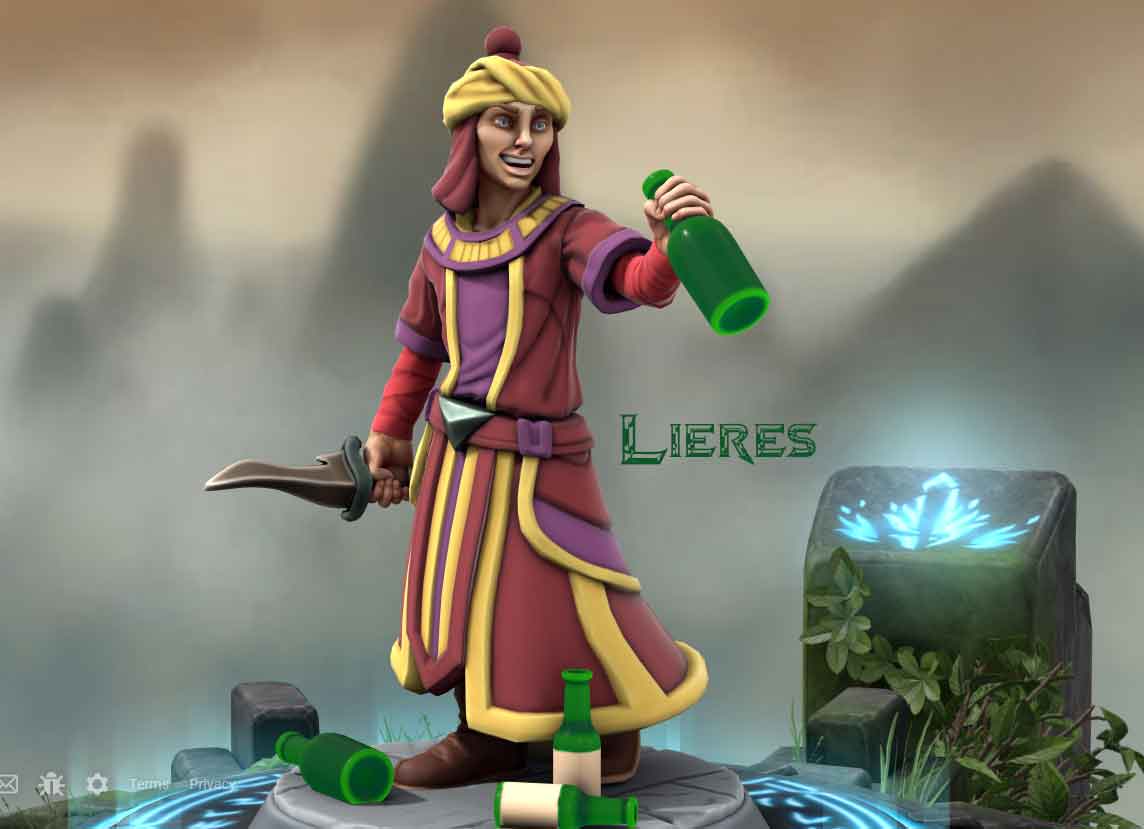
Lieres, Level-1 Thief (former Alchemist):
Addict, Lush, Charming idiot

Róinseach, Level-0 Mushroom Farmer; Gung-ho,
Desperate to get off the farm, Stupidly lucky.

Shazoruval, Level-0 Barber/Chiruregeon; Pessimist,
Superstitious, Suprising leadership, Talks to Giants.


Friday, October 16, 2020

Building an Adventure (pt. 4): Plugging it into the System

Photo by Robert Coelho on Unsplash
Okay, now I have a solid outline and plans for an encounter. Now I will need to turn this into something usable.

For the purpose of this article, I will use BD&D, so anyone with Old School Essentials, Labyrinth Lord, or Lamentations of the Flame Princess can use it one-to-one., and people with AD&D-based systems like OSRIC or Astounding Swordsmen and Sorcerers of Hyperborrea will be able to do so with minimal work.

Also, If you like this adventure, an updated, cleaned-up and slightly expanded version of it is now available on DrivethruRPG.

Plugging In

One of the most useful things that you can remember about adventure writing is that the best plans should be thought up independent of game engine.  Trying to think in terms of challenge ratings, stat blocks, point rewards, etc. can put boundaries on your creativity .

This is the difference between asking "What ideas can I make work in this system?" and "How can I make my ideas work in the system?"

The latter approach may require hacking or modifying the rules, but you will come  up with a much better, more memorable adventure. Often one with more unique content

"Plugging your ideas in to the system" can be a process that takes time and tinkering to do, but is worth it.

For purposes of this article, I will write the encounter in the format I use for my pamphlet Adventures. I have a more optimized method I'm using for writing larger modules, but this should be sufficient for our needs; not to mention fairly familiar to most people who read older Dungeons & Dragons modules.

Consider everything below this point to be part not in a sidebar to be of a module titled "The Bloody Engines of the Dinosaur Men" (working title) done under the OGL.


Friday, October 9, 2020

Building an Adventure (pt.3): Encounter Design

Image by OpenClipart-Vectors from Pixabay

This is part three of my detailed rundown of adventure creation. In these articles, I'm focussing on the decision making processes that lead to the creation of an adventure.

UPDATE: If you like this adventure, an updated, cleaned-up and slightly expanded version of it is now available on DrivethruRPG.


A Note on Party-Specific Design

If you're building an adventure for home, then tailoring the adventure to your particular characters can be very valuable. What I'm doing here is developing an adventure that could be published and shared with everyone.

As I pointed out on my article on Rationale, this in and of itself leads to certain assumptions. First, we have to assume that nothing is going to be used as written. You don't need a lot of complex specifics, highly detailed description, for background material that fits into other campaign worlds. In fact, too much of that will Peter waste of time, energy, and money. The real goal for writing a module is to create a jumping-off point for a Game Master, and assume that they are going to customize the hell out of the adventure. Therefore, focus on making it easily customizable.

If you're only writing for your own group, building challenges that will let the various members of your group shine is helpful. This means taking some time to asses what your PCs are capable of, and what class features the players favour.

For example: my playtest group is particularly good at handling high places. They keep a lot of grappling hooks and equipment that makes them better at climbing and moving vertically. The party thief has a set of magic wings that allow her to take flight. The party wizard is quick to use tenser's floating disk as an elevatorfor safety net. The danger of a fall is less frightening for them, and so if I were building this adventure with just my group in mind, I might find an alternative threat to having them fall into the machines. But I might make a thrilling vertical battle.

Likewise, I am recycling the boiler encounter. They have already tested it for me, and gave me a huge thumbs up for the tense design. I will probably replace the boiler with some kind of hostage situation that allows them to employ stealth deception, and magical tricks, as my group excels in those fields. Whatever I choose, it will probably be something I would like to use in a future adventure.


Encounter Design Tools

When I design encounter, I like to refer back to the Three T's that Hankerin Ferinale published in Index Card RPG Core 2E; I also look for an opportunity to create iconic moments where characters get to play at the fantasy archetypes that they built their characters on.

Finally, like the true grognard that I am, I'm not particularly interested in balancing encounters. I am, however, interested in making sure that everyone has a good time. To that end, I trying to make sure that players handling things intelligently will not face a tpk. For that reason, I like to leave an out or a bypass to any encounter.

My game of choice for my playtesting group is Index Card RPG. It is built on a Dungeons & Dragons core, but tightenrd for faster play. ICRPG characters mathematically work out to the equivalent of a second level Dungeons & Dragons 5th edition character, or characters between 3rd and 5th level in older editions of Dungeons & Dragons. You can simply use OSR monster stat blocks without modification with ICRPG as long as you make that your assumed level of play around 4th.

(Typically, I will build an adventure using OSRIC or Basic Dungeons & Dragons and then play it with ICRPG.)


Thursday, October 8, 2020

Building an Adventure: Side Note on Rationale

"Blacksmith" by Clicker-Free-Vector-images
From Pixabay

When planning an adventure, a GM often has a rationale for making it that will strongly inform their design choices.

For example, a Game Master whose goal to write an adventure to show off how clever he is will create a dungeon full of traps and tactically complex encounters. His design will likely reward rules mastery.

On the other hand, an adversarial Game Master who wants to see players struggle to outlet him, will likely build an adventure with several incredibly tough boss monsters, traps and ambushes that provide little warning, and the odd trick that confuses or humiliates.

The Game Master who is there to tell a story well have huge amounts of world building, lots of lore to discover, and very complex NPCs with a lot of behavioral triggers. They will be likely to try to build balanced encounters.

Personally, I prefer to write an adventure with the guiding objective of the players coming out of the session feeling highly entertained. I want to make sure my dungeons are fun, and believe that fun comes from a mix of challenge and high-risk situations with commensurate reward.

I also believe that fun comes from creativity. I tend to present challenges that are open tl multiple creative solutions, but don't give any obvious ones to the players. If you put a problem in front of a player character and let them think about what assets they have for a moment before you demand action, they will usually come up with something you never would have thought of in the first place 

Tuesday, October 6, 2020

Building an Adventure (pt. 2): Example of Brainstorming & Outlining

Image by Clicker-Free-Vector-Images

This is part 2 of my series on the thought processes and choices made when designing a role-playing game Adventure. While the example here is for Dungeons & Dragons, or a retroclones thereof, most of what I am sharing is true for any role playing game with a traditional GM and PCs setup.

Throughout this article, I will be planning an adventure, first by covering the steps detailed in the previous article, and then turning that into an outline of encounters to use.


Starting at the End

As I mentioned in the previous article, I wanted to recycle an encounter that I created and tried out on my playtest group, but I wanted to place it in a different dungeon. That encounter involves trying to save 18 prisoners scattered across a complex of five or six rooms while on a tight timer. If they fail, a chambers with flood with steam and boiling water, killing the prisoners.

This means I need a dungeon with a massive boiler or a geyser. Better a boiler to explain why they haven't been killed already. I also need someone who have captured them and drag them off to this steam works dungeon. The dungeon itself should be full of steam-powered machines. It will need a fuel source to keep the boiler going. and I need a reason why this team is being used in the first place.

Because I tend to rate for the OSR crowd, by default, I want to make it something I can generally fit into an anachronism-filled 14th century Europe analog. A sinister Victorian factory could be a lot of fun, but isn't quite a fit for a generic OSR product. I want this adventure to be something that a GM can lift, flavors he wants, and drop into their game without too much hassle.

Thanks to the implied post-apocalyptic setting of the average fantasy game, it's easy enough to make the place ancient rather than something new. After all, the ancients before the unspecified cataclysm of the average dungeons & dragons world for clearly more gifted in magic, why not technology as well?

This should be an adequately weird but Sword and Sorcery compatible setting, and give me some cool ideas for visual design. 


Monday, October 5, 2020

Building an Adventure: Endgame, Style, & Structure


Image by DariuszSankowski from Pixabay
I got a lot of good response from articles by discuss about of thought processes of going through DMing tasks like using a one page dungeon. So, I'm going to go over my thought processes for planning a short adventure.

NOTE: After writing  this series, I published an an adventure based on the examples, which is now available on DrivethruRPG.

Starting at the end

My adventures are rarely linear. Although, when I set out to write them I try my best to think of at least one scenario at the end of the adventure where the players have a good reason to cheer, and their characters to smile as they bandage their wound because of their great victory.

This isn't always the end of the adventure, but it should be the climactic encounter. Depending on the type of adventure you decide to run, this could be a singular tentpole monster, or the point when the adventure's objective is in the greatest peril of failure, or it could be a big boss monster at the end of the legion of minions. In a game of social encounters and combat, it is likely when arrival gets laughed out of court or taken away in irons.

For the purposes of this adventure, I want to recycle an encounter that I wrote for my playtest party, as a bridge between my modules (the one I planned out loud on Twitter last month.)

The climactic encounter is one in which the player characters have to rescue captives from several different locations as a gigantic boiler begins flooding the entire dungeon with scalding water and steam. The rooms are several rounds of running apart, and each has its own time baffle. A particularly noble character can attempt to vent some of the steam and slow down the flood, but only by taking increasing amounts of damage every round while they work the boiler

When I ran this encounter last time, my players said that it was the most fun and stressful encounter they played in the entire campaign I wasn't happy with the rest of the dungeon, however.

Knowing that this is what I want, means I know about a lot of moving parts: I know that the mission involves rescuing people. I know that it requires several rooms at different elevations. I also know that steam or machinery themed enemies and traps would be ideal. This gives me plenty to work with.


Deciding on Your Adventure Type

There are quite a few different types of adventure. Each one has particular challenges and it's design, and particular foils to look out for. I'm sure that's an exhaustive list of categories is nearly impossible to achieve. I am going to cover a few here in brief.

Friday, October 2, 2020

Literary Archetypes and Encounter Design

Photo by Djedj from Pixabay

When designing adventures, many GM's make it a point to try and give every character a chance to shine. This is a great practice in theory, and givrs players an opportunity to really play their characters to th hilt. In practice, however, it often boils down to making sure that there's some undead to turn for a cleric, a bunch of mooks for the fighters to demolish, and a trap to disarm.

There is a fundamental flaw in the way that this idea is often executed or described to new DMs, The  reflect the mechanics of a character class, but they don't reflect the character. Do that, you have to establish why they're playing the character that they are. 

Hopefully, that is not in the name of "party balance." Player should never have to feel like they must play a character they don't enjoy to fill a checkbox.

Of course, if you are building your characters as Crom intended, and rolling 3d6 down the line, then, the players are playing the characters that the dice gave them, and hopefully enjoying the experience. At which point, the question becomes what is most enjoyable about the character they have.

A good starting point if you are playing with randomly generated characters, are writing to publish, is to look at the literary archetypes on which characters are built. Each class in D&D is built to enable a player to emulate a range of heroes from the body of literature that inspired the game: Appendix N.

The same is true of every other class-based RPG: they are built to emulate either genres of literature (been I include cinema, comics, video games, and television) or specific works. Each genre has its set of archetypes and stock characters. The classes are a way of distilling the abilities of that archetype down into something gamable.

But the trick here is to remember that the map is not the territory. A class lets a character do the sort of actions that the archetypal character often does in the process of their heroics, but that is not the same what those heroics are.