Showing posts sorted by relevance for query tiny dungeon. Sort by date Show all posts

Friday, September 4, 2020

Game Review: Tiny Dungeon 2e

Game Review: Tiny Dungeon 2e

Tiny Dungeon 2e cover art 
by Michael Leavenworth,
©2018, Gallant Knight Games

Author
: Alan Bahr
Publisher: Gallant Knight Games
Marketplace: DrivethruRPG
Engine: Tiny D6

I first heard about Tiny Dungeon 2e through Bundle of Holding, when it was featured with a bundle of other rules-light indie games ("Indie Cornucopia 6"). I was immediately attracted  me by the cover and the description: 

Powered by the TinyD6 engine, with streamlined mechanics that utilize only one to three single six-sided dice on every action, characters that can be written on a 3x5 notecard, and easy to understand and teach rules, Tiny Dungeon 2e is great for all groups, ages, and experience levels!

This was when I first looking for a fast and easy game to replace D&D5e. While nothing else in that bundle appealed, Tiny Dungeon kept calling to me. I picked it up and was immediately taken with its clean, simple mechanics, and clever flourishes.

I ran a trio of short adventures for my wife the day after I bought it, and after she said: "I like it. In fact, this might be the system I finally DM." Within a week, I'd ordered a POD hardcopy. Then I bought the Space Opera game Alan Bahr had written on the same engine, Tiny Frontier Revised for myself, my best friend, and my brother who loves TTRPGs, but works closely with people from WotC, runs games for his office, and makes D&D-based video games, so won't do fantasy games on his off hours.

In other words, I like it. I've run a couple of short campaigns with it, and it goes in the backpack for short trips. I even used it to teach my son the rudiments of dungeon crawling fantasy games.

Friday, May 21, 2021

Tiny Dungeon 2e with Kids: When Kid Games Aren't Enough

Tiny Dungeon 2e cover art 
by Michael Leavenworth,
©2018, Gallant Knight Games

 When I started playing role-playing games with my oldest son, I started with No Thank You, Evil! by Monte Cook games. NYTE has hey wonderful and whimsical setting, and very simple mechanics.

While it is certainly possible to tell more sophisticated stories in No Thank You Evil! , the fact of the matter is that the game is a pretty limited scope. It's system of fun points, for example make it very difficult to tell a story that doesn't involve the characters being able to stop and have a snack whenever they want to. It lacks tension. More importantly, it lacks any serious sense of a moral frame: while it is called No Thank You Evil!, there is no struggle of good versus evil built into the game. I would argue that it's so long as you're using the setting for which the game is designed, there cannot be. It just isn't supported by the game's structure. All villains are misunderstood but basically good at worst. 

In my household, I believe in teaching my children about the ideas of Good and Evil and how they look both in Myth, and in real life. Accordingly, I have raised them on Norse mythology, The Chronicles of Narnia the actually good Star Wars movies, old superhero cartoons, and even older children's books from an earlier era where there were always clear good guys and bad guys.

My son noticed pretty early on as we played through the pre-designed No Thank You Evil! scenarios was that the thrilling heroics, and struggles of Good versus Evil simply weren't there. And that disappointed him. He wanted more from his role-playing game than NYTE could offer. 

He had, in effect matured beyond what NYTE is structurally capable of offering

Obviously, the easy solution to this would be to move to a role-playing game more in line with the Mythic. And that is why I quickly turned to Tiny Dungeon 2e.

I have already reviewed Alan Bahr's  Tiny Dungeon . It's a game, I've liked enough to buy twice, and I don't feel like I need to repeat any but the most basic points about that review here. I do, however, want to say why I chose it as his next step... 

Thursday, January 21, 2021

Game Review: Tiny Cthulhu

Game Review: Tiny Cthulhu
Tiny Cthulhu Cover Art by 
Tom Brown; ©2020 Gallant
Knight Games

Author: Alan Bahr
Publisher: Gallant Knight Games
Marketplace: DrivethruRPG
Engine: Tiny d6

I am a Cthulhu Mythos fanatic, and have a bookshelf full of Lovecraft's fiction, and the work of his circle and modern "Lovecraftian" authors to show for it. One of my all-time favorite campaigns in any system was one I ran designed as a mashup of The Silver Key, The Festival, Celephais, the video game The 7th Guest, and the anime series Witch Hunter Robin.

Oddly, I have never played the original Chaosium Call of Cthulhu. I found the version of the rule-set I got my hands on was unappealing. But Call of Cthulhu d20 was one of my favorite systems, and still sits on my shelf.  The problem is that Eldritch Horror just doesn't jive well with a level-based and combat-heavy system like d20. and the charm of that adaptation wears off pretty quickly.

I've tried to capture the Cthulhu Mythos in a lot of systems since: Mage: the Ascension, the new World of Darkness, GURPS, Cypher System... All with mixed results.

I am also an Arkham Horror junkie. 

I have a theory that the Mythos really does need a purpose-built system to work. Games built to make characters the heroes, or at least give them a fighting chance often fall flat. And I have been looking for a good CoCd20 alternative to tell my Weird Tales. I was thrilled when I heard that Alan Bahr was taking a stab at the Mythos in the chatter after my recent interview with him.  I've been watching the calendar for my shot at this review for months. And I am not disappointed.

Tuesday, May 25, 2021

Kids and Four Against Darkness

For Christmas last year, my mother-in-law sent me the fantasy solo RPG Four Against Darkness. You can see my review of it here.

Four Against Darkness simulates a four character party exploring a dungeon on a quest to slay one particularly nasty boss monster. On each turn, you randomly generate a dungeon room that gets added to your existing map. We then randomly generate what your characters discover in it, and if it is monsters, you have a chance of negotiating (and losing the initiative if the monster is hostile,) or taking the first strike. A system of discovered clues and friendly NPCs allows additional goals to emerge during play, and possibly add a campaign element to the way the game is played.

At the end of the day, it's not a game with a great deal of depth: You explore the dungeon, you slay the monsters, you loot the room. Sometimes the monsters ask you to kill a different monster. Sometimes you find a weird puzzle, or a clue that will eventually allow your characters to score an artifact. Its a simulation of  5th edition beer and pretzels game. And sometimes, that's all you want.

Not to mention the fact that it is awfully handy for testing the mechanics of other games.

Shortly after I received it as a gift I started playing it on my laptop using Keir's Dungeon Scrawl. A favorite program of mine that I've used for dozens of projects, personal and professional.

At one point, my son climbed up onto the couch next to me while I was playing a round, and instantly figured out that this was some kind of role playing adventure game - he knows a dungeon map when he sees one - and asked if he could play, too.

Wednesday, June 23, 2021

Review: D12 Monthly - Issue 1

Editor
: Russ from YumDM
Marketplace : YumDM.com
Engine: Edition Agnostic Dungeons & Dragons

D8 Monthly has been renamed to D12 Monthly. Issue #1 is the second offering in this series of free monthly zines. They've done a good job of establishing a format that works. It includes a couple of columns that we have seen in past issues

  • Corner Table provides one random encounter table to be used in game
  • Location, Location, Location gives you a short dungeon, town, or adventure site.

Issue #1 also offers quite a few more feature articles.

The feature articles in this issue are:

  • D8 Dungeon Generator a simple tool using d88 to stock a dungeon combined with guidelines derived from the five room dungeon concept to create fast and easy dungeons.
  • Leveling Your Encounters is an introduction to the two articles that follow it, suggesting how they can be combined to create a fast and easy encounter rolling method.
  • Encounter Distance is a simplified d6 table for determining encounter distance when rolling for wandering monsters.
  • What the Hell are the Monsters Doing? offers a simple random table for determining what monsters are up to.
  • Building a New Monster is advice on and an example of re-skinning and modifying an existing monster to create something new, and a discussion as to why a DM might wish to do so..
  • Building a Quick NPC builds on the map method of NPC design introduced an issue zero by adding random tables for motivation, appearance, and personality.


What I loved

Return to Dolfar

The Firststop Inn and the Quiss' Basement Dungeon build upon the setting that was established in issue #0, the small town of Dolfar. It both adds new locations and new PCS to the town, and gives us an adventure location, villainous assistant, and five-room dungeon that player characters can explore in the town, built around an NPC introduced in issue #0.

This is a clever way to write the Zine. It means that we have a reason to keep coming back, and if Russ keeps developing related locations, we have a a good chunk of a campaign contained in the pages of the zine by the end of the year. It also allows Russ to have a purpose for the examples and content that he includes in the Zine. 

Thursday, September 3, 2020

Developer Interviews: Alan Bahr

Growth and Responsibility: An Interview with Alan Bahr

Alan Bahr is the creative powerhouse behind Gallant Knight Games, a company that produces some of the most creative projects on the small press indie game scene. He has helped bring the Brazilian OSR to North America with projects like Knights of the Underbed, and has helped make ultra-light minimalist games, like his Tiny Dungeon 2e, a big part of the current wave of Indie games.

As always on W2tDT, the answers here are unedited, unabridged, and entirely the Author's own. 


W2tDT: You have made a lot of cool games. Some are pretty straightforward, like Tiny Dungeon and Tiny Frontier. Others are really unexpected: like Moods of the Mad King, a game about entertaining a tyrant and Cold Shadows, a le Carré / Ludlum inspired game of espionage that is built on Trust and Deception. You even have a game about playing Gods! Where do you get your ideas?

AB: Oh wow. I don’t have a good answer for that. I’m really inspired by music and art I see, and I find myself responding to cool media I find and using that to try to leap-frog into new styles of games.

From Hell’s Heart was written entirely to use public domain art from a single artist (yes, I found art I liked and wrote a whole game to justify it.)


Which of your games are you most proud of?

That’s hard to answer. I love the whole TinyD6 line, but I think Cold Shadows is probably my favorite. It’s an underserved genre and I’m really proud of what we did (especially considering it was the third game we ever released and it was a big jump for us in terms of mechanics and production.)


Many of your games are built on the super-minimalist TinyD6 engine. It is probably one of the three lightest systems I have played. Why focus on the minimalist angle in games?

Everyone has fun differently, but I found that my style of fun (fast resolution, rules light, easy to teach and play) was hard to find in games on the market at that time (partially because I didn’t know where to look). Tiny Dungeon really lit a fire under me and I wanted to keep going with it. 


What is different about playing a minimalist game vs. playing a crunchier system like Pathfinder? What does a game master have to do differently when he is running a minimalist system?

Well, I think a GM has to be prepared to fill in some gaps. I’m fond of saying in panels that the goal of TinyD6 is to get you 90% of the way there, and the last 10% is all the GM and what makes your game YOURS. 


Obviously, a minimalist game, like an OSR game requires a focus on making rulings not rules, being reasonable, logical, and open-handed as you run the game. And you have to reward player creativity. What do you think is a major difference between playing in minimalist system and playing an OSR game like OSRIC?

On a philosophical level, not much. I think they follow a lot of the same principles in terms of openness towards modification and exploration of what the mechanics can and can’t do. I think TinyD6 is more forgiving in terms of lethality (though that’s a different debate, I suppose), so the GM should feel enabled to make mistakes and grow. It’s a very forgiving and rewarding game system. 


Over the last few years, Gallant Knight games has become, to my mind, a place where you can see some of the most imaginative projects coming out of the small press scene. I’m thinking of games like Knights of the under bed, Gears of defiance, and Solar Blades and Cosmic spells. How would you describe the Gallant Knight ethos for choosing which games to publish? What makes you look at a project and say that it is a Gallant Knight game?

It's super simple: would I want to play this game at my table with my gaming groups? If my gut reaction is “hell yes”, then we’re all in. 


You have a reputation for being a mentor to other game developers and someone who knows how to boost the signal for other developers and great organizations. I’ve noticed your name in a lot of special thanks and Acknowledgements sections of Indie Games I picked up over the years. How important is mentorship, do you think, to this Hobby?

That’s the first I’ve heard of this! I’m gratified to hear that it’s such a thing, but honestly, I’m just a passionate fan of games. I’ve never lost that “fanboy” feeling I get around other game designers, and I just want to see them be successful. 


Is there anyone you would love to turn my readers attention to right now? A worthy cause or a great new project?

Well, at the time of this writing, Gallant Knight Games has For Coin & Blood: Second Edition up on Kickstarter! It’s a classically inspired grimdark fantasy RPG (inspired by RPGs from the 70s and 80s) where you play the stories of gutterscum and villains. 

I’m personally really excited for the Free League version of Twilight 2000. Free League is one of the best and most exciting publishers on the market and I can’t wait to see what else they do.


And how about yourself? What are you working on right now?

Well, we just put Tiny Cthulhu to layout, so that’ll be shipping soon! Other than that, I’ve got a lot of freelance work I owe folks (sorry!) and I’m actually kinda taking it easy on GKG projects for the next few months while I clear our backlog, catch up on errata style busy work, and work to improve our operations. 

I’ve got a few long-simmering projects I’ve recently turned my eye to that I’m very excited about, so we’ve been doing some playtests. 


After I bought my second copy of Tiny Dungeon 2e, I watched the year-long campaign you ran with Victory Condition Games to showcase it. It was a campaign that really went off the rails; you had a character who set fire to things and got other characters killed in almost every session. You had players who would appear and disappear. And you had, towards the end, a pair of completely ridiculous PCs that I don’t think anyone would quite know how to run. I have, since I first conceived this blog, intended to write an article about the after game discussion you had at the end of that campaign. You sat down and talked very frankly about your part in how the campaign had gone so wrong. Especially how the biggest role of the GM is providing direction and leadership to the group. That had to be hard to do in an open forum! To me, it was absolutely stunning to watch someone display that level of self-Honestly. Do you think that campaign has had an impact, good or bad on you in the long term As a GM or as a designer?

One of the great parts of running games online and publicly is that all your mistakes are nice and visible forever. 

It’s definitely impacted how I talk about GMing in the books we publish, how I talk about GMing at conventions, and how I communicate with players (in person, online and through any medium.) 

It was a lot harder on me than I expected, and it damaged some of my self-confidence I think, but if I’m being honest, I needed to be challenged and I feel like I was better after being pushed to grow as a GM.


You made the transition to full time game developer in 2016, and then in 2018 you went back into the full-time workforce for the best possible reason: to be a Dad. So few people in this industry ever get to be developers full time. I'm envious...

Hah! It’s like a lot of jobs where you spend more time doing the non-fun parts than the fun parts 😊


...What advice would you give the guys who are aiming to develop games for a living?

Be patient, be smart with money and finances, and make sure you learn everything you can. It’s a lot harder than expected in some ways (and some things are a lot easier.) Everyone make and plays games differently, so you have to make your own mistakes, so you can grow into the designer that only you can grow into. 


...Do you think it is possible to have financial stability while making games? What would someone need to do to make that happen?

I think this is really a big conversation, frankly. Short answer is: yes. This is a topic that gets me really fired up, so I’m sorry for the wall of text!

But there are some hurdles that need to be adjusted in the industry. Consumers, publishers, distributors, and streamers all share a responsibility to ensure the industry can sustain and support the wonderful creativity that comes out of it.

Piracy is a real problem in the game industry (some of my angriest twitter rants have been piracy focused.) Consumers need to be willing to pay fair prices for the games they want to consume (RPGs are an insane return on investment for what they cost. They’re cheaper than a movie most times and you can do it repeatedly without purchasing more!)

Publishers need to set up and hold each other accountable, both in terms of what we pay freelancers (a sustainable wage), and what we charge. The “race to the bottom” pricing that you see only harms other publishers (and eventually yourself.)

Distribution is a whole can of worms. I’m really glad I have such a great distributor (Studio2 is wonderful.)

Streamers, actual plays, and those who monetize RPGs in artistic and creative format like that have a responsibility to promote and share games. Streaming is such a wonderful new frontier for tabletop RPGs and it’s so exciting to see all the amazing things that come out of that community. It has the potential to revolutionize the way RPGs are consumed, but when wielded improperly it can be harmful too (as can be seen sometimes.)


Thank you Alan, for your time, and a shelf full of amazing games!

Thank you!

Tuesday, November 2, 2021

My Top 5 OSR and Non-OSR Indie RPG Roundup

 Friday night while chatting with my wife (who's has avid a gamer as I am,) I ended up discussing what I like about my favorite OSR systems, and my favorite NON-OSR Indie and small developer systems. It turned into kind of a "round up," and I thought I would share it here in a slightly more polished form.

This article isn't as objective as the reviews I usually offer. It's very much subject to my own taste. But, I hope it might help you find games you enjoy if you're anything like me.

Friday, September 10, 2021

Game Review : One Shot in the Dark

Cover for "One Shot in the Dark"
Art by Tale of the Manticore
©2021, Tale of the Manticore
Author: Tale of the Manticore 
Publisher: Self-published 
Marketplace: DrivethruRPG 
Engine: OSR inspired ultra-light

It has been a busy few weeks in the deathtrap. I have had a 3-day journey across country, got my kids back to school, and dealt with the death of a pet. Accordingly, I have a bit of a backlog on reviews. The one I have been most interested in reviewing has been the hardest one to get reviewed. Finding time to sit down at a table with a deck of cards as being stunningly difficult for the last month. That review is for One Shot in the Dark by Tale of the Manticore.

One Shot in the Dark is a solo dungeon crawler in the same vein as Four Against Darkness. You control four simple characters in a theater of the mind dungeon crawl.

The dungeon is generated by drawing cards. A heart is drawn to determine the room, with traps, the presence of monsters, or magical challenges listed. Diamonds are drawn for monsters, and clubs for treasure. Each floor of the dungeon has three tables to consult, giving each floor a unique feel. It would be fairly easy to write additional or alternate tables to create different themed adventures. After three floors, the PCs draw a spade to discover the final monster of the dungeon.

The actual game mechanics are minimalistic, A party of four can easily fit on an index card. Your party automatically consists of the four basic classes of B/X Dungeons & Dragons: Fighter, Thief, cleric, and Magic user. Each character has a level, hit points, and they hit die. They roll for extra hit points up on levelling up and make attack and damage rolls. Clerics and Wizards have one spell each from their respective class list, and gain a new spell up on levelling up. This spell may only be used once and duplicates are not allowed.

Attack and damage rolls are handled using the hit die.

The game is a simple exercise in imagination. It is significantly faster than Four Against Darkness and other solo games that I have played.

I would imagine that it would be very easy to steal either the ultra-light rule set or the dungeon building game and use either separate.

Saturday, January 2, 2021

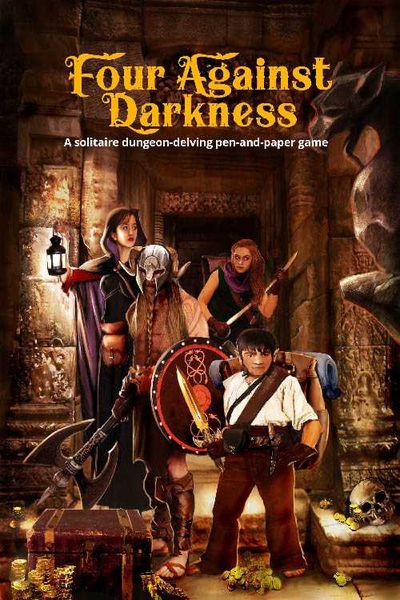
Game Review : Four Against Darkness

 
Game Review : Four Against Darkness

Author: Andrea Sfiligoi
Publisher: Ganesha Games
Marketplace : Amazon, DrivethruRPG
Engine: Four Against Darkness (vers. 4.0)

Four Against Darkness is a solo dungeon crawling game that borrows its aesthetics and tropes from Old-School Dungeons & Dragons, and in a pinch it can serve as an extremely rules-light OSR TTRPG.

I have never played a solo game before, and as my modules are popular with solo RPG players, I wanted to try them for myself. I've grabbed solo games of varying vintages and levels of complexity from the highly sophisticated Ironsworn, to the essentially rules-free Alone Among the Stars, to the venerable Barbarian Prince to understand the experience.

Four Against Darkness is by far my favorite of the solo games so far.

4AD is an unpretentious stomp through a randomly generated dungeon with a group of four low-level adventurers seeking treasures and to defeat the evil master of the Dungeon. It does a good job of simulating the experience of playing a hack-n-slash / kick-in-the-door style game of B/X D&D.

Wednesday, February 24, 2021

An Incomplete but Helpful List of Easily Ported Rules (WIP)

Image by Borkia from Pixabay

I have no idea what this little project is going to turn into... probably a searchable blog or database once I have gotten a little further into it. I wanted to list a series of optional rules I've run across in the Indie TTRPG scene that I find valuable, including where they can be found, what genres they might best be used in, and some keywords for playstyles.

This is going to be a living project where I add a few every once in awhile, and see how it evolves.

I will not include material I have seen presented as an optional rule in the core book of a current pooular TTRPG. For example, I do not include Advantage / Disadvantage because it is a rule in the core of D&D5e, and readily visible to anyone in the TTRPG community. This is meant to draw attention to options you might not have discovered. 

In each entry I have a "Find it In" section; this does not list the original appearance of the mechanic. Instead I list where I have seen interesting, innovative presentations of the mechanic. I give priority to games that are free, open culture, or at least have a downloadable quick start manual, or that cost less than $10. And I link to where the rules can be accessed most easily in my experience. 

I also have sample Keywords that cover descriptions of kind of feel or experience the mechanic supports. If a rule works well to make a campaign feel "Dark", then that is where I list it. This will let you easily use this list with the Poster Pitch tool I have presented in part one of my two-part guide to rules hacking. 

Likewise I have listed common genres of TTRPG that this specific rule will support well. 

I ask you for your feedback: Is this a project worth expanding and developing

An expanded, indexed blog version of this list is now avaliable 

Wednesday, January 11, 2023

The Lo-fi Online Gaming Manifesto

The Lo-Fi Online Gaming Manifesto

"Lofi Girl" CC-BY-SA 2022 Firstman2507
How to play a TTRPG online game using only the technology that adds to your game.

The Disaster

Back in October of 2019, shortly before I started my blog, I ran a game of the 2017 edition of PARANOIA for friends online. I was hoping it would be the first of a series of events built around that game, and I really wanted to wow my players.

I planned on wowing my players. To that end I wrote secret journal entries for each player with their faction mission complete with graphics that would pop up.

I drew a map of the area I could slowly reveal using the fog of war using Roll20.

And then I spent nearly 5 hours sniffing, writing down, and programming in the various cards used in that edition of the game. Creating several unique card decks in roll20 is a nightmare at best.

The actual event was one of the worst sessions I've ever run.

Saturday, October 8, 2022

Game Review: EZD6

Cover, EZD6
C 2022 RUNEHAMMER Games
Author: Scotty "DM Scotty" Mc Farland

Publisher: RUNEHAMMER Games

System: D6 variable target system

Marketplace: DrivethruRPG

EZD6 is a rules like role-playing game by YouTube's DM Scotty, and released through room Hankerin Ferinale's RUNEHAMMER imprint.

It is a straightforward fantasy / sword & sorcery dungeon crawler in the vein of Dungeons & Dragons. it definitely has strong OSR aesthetics, but is exceptionally rules light. I would say that is only slightly crunchier than Tiny Dungeon 2e.

The System 

Uncertain tasks are resolved by a d6 roll against a variable Target number by the "Rabble Rouser" (GM) between the two and six. Rolls of one always fail, sixes always succeed.

Tuesday, April 11, 2023

Let's Build an RPG! (pt.3)

"Tom’s father begs Merlin the magician
to give his wife a child" 
by Leslie Brooke (1922)
 About a month ago, my youngest son asked to play an RPG with him like he sees me do with his brother.  My first inclination,  after years of gaming with my oldest, and trying Kid-oriented Fantasy RPGs such as Hero Kids, First Fable, and No Thank You,  Evil! was not to reach for a system at all, but to break out my diceless FKR-style system, Square Dungeon.  

Rules constrain and distract. They can become a sticking point for new and young players especially.  The whole point of a good TTRPG is to facilitate a game of narrative exploration and creative problem-solving. If you are too caught up on what The dice mechanics cover, and looking for the solution to all of your problems on the character sheet, your game is failing you.

The Best System is a Minimal System

Thus, the best game for a new player is the one that is not much more than a task resolution system and a fail state.

Rules otherwise serve mostly to enforce a consistent set of constraints to make play more complex and challenging,  and to help express the limitations and possibilities of the game world. The rules of Dungeons & Dragons,  for example create a world in which magic works a certain very simple way, in which combat has a certain level of peril, and resources have to be managed in specific ways. This makes the game both more challenging to play, and helps create a  certain kind of Fantasy world more effectively. 

Thus, when working with kids this young you can let the rules slide, and focus purely on the fundamentals of game-play. Then work your way up to D&D,. Then onward to other systems as the player advances and needs more challenges and variety.

Tuesday, January 3, 2023

Book Review: Return of the Lazy Dungeon Master

Author: Michael Shea ("Sly Flourish")
Publisher: Self-Published
System: Mostly System Neutral (w/ some focus on D&D5e)
Marketplace: Amazon, DrivethruRPG

 Here's a Confession for you: I have a hard time deciding how to best plan a session.

When I was in elementary and junior high I would occasionally draw a map and part-roll-, part-choose- a treasure hoard. I gave out more magic items than I should have, but they were usually the weirdest, most situationally useful, odd, or simply off-beat custom magic items I could choose. I ran a fusion of AD&D and BECMI D&D, with occasional forays into the Teenage Mutant Ninja Turtles and Palladium Fantasy RPG.

In Highschool I ran mostly AD&D2e, RIFTS, and Shadowrun 2e. I did almost nothing for prep. I ran it off the cuff, and didn't sweat treasure. I just rolled on the treasure tables occasionally, but mostly ignored it.

When I was in University, I managed to create a more balanced approach of at least writing down the names of a few NPCs and the major points I wanted to handle. I prepped treasure that might tempt PCs in one hoard per session, and made sure the bad guys had some interesting loot. Of course, at that point I was running Shadowrun 3e most of the time, which, contrary to popular opinion, is a really easy game to run on the fly. And occasionally HōL, which is inimical to planning.

The Disease

But then, along came Dungeons & Dragons 3e... and the game was somehow a bit traumatic to me. D&D3e had a Challenge Rating System, and for some reason, I thought the idea was so cool (maybe because I had TPKed a few parties on too-hard encounters,  and made a few adventures that were way too easy early on) that it became my obsession in adventure design. I also had problems when my players fell way behind the power curve from lack of appropriate treasure. I spent a huge amount of time on the D&D forums trying to figure out how to make best use of CR and treasures by making sure I was keeping within the parameters of "game balance."

Whenever my players found treasure, I would grind the game to a halt as I rolled the treasure hoard during a break. I eventually resolved to pre-plan a lot more of the game to avoid that.

Monday, January 18, 2021

Game Review: Alan Bahr's Tombpunk: Low-Fi Roleplaying

Tombpunk Cover Art by
Nicolás R. Giacondino & Jeremy D. Mohler,
©2020 Outland Entertainment LLC
Game Review: Alan Bahr's Tombpunk: Low-Fi Roleplaying

Author: Alan Bahr
Publisher: Outland Entertainment
Marketplace: DrivethruRPG
Engine: Custom d12

Alan Bahr's Tombpunk: Low-Fi Roleplaying is a roleplaying game designed for a very specific style of play: quick and dirty gaming that is going to happen for a few sessions in a row. It's the sort of game you would play on a family vacation, a long road trip, or while camping. It's rules are minimalistic (as I would expect from Alan Bahr), and designed to work with practically zero planning by the GM. It is probably best played totally off the cuff looking at a randomly generated map... Or just making it all up as you go along. It has mechanics to help you know when a specific improvised adventure is ready to wrap up if the room is giving you no indication.

The premise of Tombpunk is simple: you play characters in a gritty fantasy world where poverty and overtaxation have forced your character to give up a hand scrabble peasant life for the dangerous and dirty work of clearing haunted dungeons for the treasure that the monsters bring with them from the underworld.

Tuesday, June 8, 2021

Gaming with Kids: Final Thoughts

Playing TTRPGs even with small kids can be a great way to help them explore their world, and a great way to bond on a rainy afternoon. But it is going to be fraught at times with unique challenges that you aren't going to run into with mature players.

Running a game for children, especially small children can require a lot of extra work. You need to help them navigate the rules. You will need to contend with a short attention span in some way, either through the structure of your game or the volume of your content. You will need to be aware that if you are playing with your own children, or children that trust you that you are teaching values at the same time that you are playing, and make sure that your game reflects that, rather than trying to be gritty, morally ambiguous, or revolutionary.

As children are no good at advocating for themselves, you also have to exercise a significant deal more empathy. Reading the room, making sure that the kids at your table are comfortable and having a good time, balancing the game in a way that gives every player a chance to shine, and interviewing your players to figure out what they like and don't like is important. D&D tables with adults are subject to Market forces: if the players don't like the game you're running they won't come back. If you're running a game with kids, they may feel like they don't have a choice but to playay.

Most Children's role playing games has certain qualities that are designed to make them more approachable. They tend to use one die type, tend have very simple and light mechanics, tone down violent imagery significantly, and they tend to have some structural mechanism to help deal with short attention spans.

However, they also often suffer from being designed with very little respect for the intelligence of children, and, seem to have absorbed the values adjustment philosophy that took over schools back in the 80s. Namely, the idea that kids' media should have very little if any moral content or frightening material. They tend to be devoid of danger, the monsters are usually misunderstood, rather than being monstrous, and neither player characters or NPCs gets hurt.

Wednesday, November 15, 2023

Storycraft vs. Chaos: Why I Minimized Prep Time

 For about 34 of my 38 years of playing Dungeons & Dragons and similar games, I have not been a fan of random tables. I was very much in the Hickman school of gaming when I was a kid, I believed that GM should be crafting a dense narrative structure, and then adjusting it whenever the players did something I didn't expect.

The idea of buying a whole book full of random tables would not have appealed to a younger me. Even well into my 30s, I was far more interested in crafting bespoke encounters and adventures that reinforced a central narrative or collection of narratives. I tried not to waste much energy on things that felt random and unconnected to the story I was crafting.

My planning method worked like this:

Sunday, May 23, 2021

Playing BD&D with Kids

Cover to "Dungeons & Dragons Basic Rules
Set", "Dungeon Master Rulebook"(1985 vers.)
Art by Larry Elmore; ©1985, TSR, Inc. 
. I started with Dungeons & Dragons when I was six and a half years old. The boy who lived next door to me, Gregory, was a year older, and we were fast friends. He had become fascinated with D&D, and his father had bought him the Mentzer Red Box .

We only played one adventure together, but I was immediately hooked. I put it on my wish list, and fair pestered my parents for it for months, before receiving it at last that Christmas. My parents never really bought into the labels that said "for age X" on toys and games. They believed, as I do now, that you should gauge the maturity and development of the individual child

And you should not be afraid to challenge them by handing them something slightly "older" than what toy makers think they can handle. If it frustrates them, you can simply take it away and give it back to them when they're a little older. However, they can often surprise you by rising to the challenge.

As my son has played more of games like Tiny Dungeon 2e, and less of the kiddish games like No Thank You, Evil!, it has become apparent to me that this is a hobby that is going to stay with him for the rest of his life. And I wanted to make sure he had a good grounding in the original games. I wanted him to be able to make up his own mind about how Dungeons & Dragons has evolved and whether he would rather play a modern game or an old school one.

Friday, July 7, 2023

My Solo Play Evolution


 I have done a lt of solo play in TTRPGs over the last three years. It honestly never occured to me to use my games for solo adventuring until I started writing this blog and needed a way to test the games that I was reviewing.


Delve 2e
has built in solo gaming to introduce itself to the player, borrowing a note from the Mentzer Basic Dungeons & Dragons set that I though was a clever stroke. Some of my early reviews, like Tunnel Goons and Index Card RPG Core 2e were tested with my wife, but she doesn't have my head for rules and finds too many new games overwhelming. 

When Lucas Rolim sent me Pacts & Blades: Moorcockian Fantasy for review, she tapped out, and so I needed to figue out how to give it a really good shake. That's when I thought about by experience with Delve 2e, and decided to try playing it solo.

Random Dungeon Crawling

My first solo run involved logging into Donjon, and generating a random AD&D dungeon. I tend to stick to 

  • Tiny size
  • Medium Rooms
  • Polymorphic Rooms
  • Square Grid
  • Errant Corridors
  • No Stairs
  • Peripheral Entrance
  • Dungeon Level 1
  • Crosshatch Map Style

This is especially handy when you are playing an OSR games, as the monsters will be immediately usable with the game you are playing.

Donjon includes a tool for star systems, outer space freight jobs, aliens, blade runner cases, and much more these days. You could probably run almost any game you are looking for with Donjon or a similar tool.

How this method works:

Wednesday, January 4, 2023

Tool Review: Dungeon Alchemist

 Dungeon Alchemist by Briganti SV is a tool I have been watching since I first saw a Kickstarter for it a little over a year ago. It is a map drawing tool designed specifically for TTRPG mapping.

When I saw it was in early access on Steam, I put it on my wish list. My younger brother, Level 0 Luke, pulled through for me, and it is a lot of fun to use.

Here is a map I have designed with my son's as a larger-scale example of what can be done with it:

Much of this map is animated with sparkling water, crackling electricity, and turning water wheels when actively I. The program works a lot like Dungeon Scrawl: You choose an overall room style, such as castle, village, desert settlement, or ruin, and a terrain type.